Die Fischnetzstrategie ist die operative Content-Architektur von Loud & Lexis: Markeninhalte werden nicht als Sammlung einzelner Artikel publiziert, sondern als bidirektional vernetztes Geflecht aus einem Pillar-Artikel pro Themenfeld und bis zu 15 Topical-Artikeln. Das Ergebnis: eine 3,2-fach höhere AI-Citation-Rate gegenüber Standalone-Seiten, laut Yext-Studie 2025 über 6,8 Millionen gemessenen Citations.
The Fishnet Strategy is the content architecture model developed by Tobias Peschke in 2026 at Loud & Lexis: brand content is not published as a collection of individual articles, but as a bidirectionally networked mesh of one pillar article per topic area and up to 15 topical articles covering specific sub-aspects.
The Fishnet Strategy is the operational content architecture of Loud & Lexis: brand content is not published as a collection of individual articles, but as a bidirectionally networked mesh of one pillar article per topic area and up to 15 topical articles. The result: a 3.2x higher AI citation rate compared to standalone pages, according to the Yext 2025 study of over 6.8 million measured citations.
- 01Was ist die Fischnetzstrategie? Definition und Grundlagen
- 02Pillar als Knotenpunkt, Sub-Artikel als Stränge
- 03Der Similarity-Korridor: Embedding-Analyse
- 04LLMs als symbolische Fische in besonders gut gewebte Netze
- 05Wie Loud & Lexis die Fischnetzstrategie operativ umsetzt
- 06Worauf Sie bei der Auswahl einer GEO-Agentur achten sollten
- 07Häufige Fragen zur Fischnetzstrategie
- 01What is the Fishnet Strategy? Definition and Fundamentals
- 02Pillar as Hub, Sub-Articles as Strands
- 03The Similarity Corridor: Embedding Analysis
- 04LLMs as Symbolic Fish in Well-Woven Nets
- 05How Loud & Lexis Operationally Implements the Fishnet Strategy
- 06What to Look for When Choosing a GEO Agency
- 07Frequently Asked Questions
Das Wichtigste in Kürze
- Die Fischnetzstrategie organisiert Inhalte als verbundenes Netz aus einem Pillar-Knoten und bis zu 15 Topical-Strängen, das mehrere parallele LLM-Sub-Queries gleichzeitig bedient.
- Jede komplexe KI-Suchanfrage wird intern in 8 bis 12 Sub-Queries zerlegt (Query Fan-Out), wobei jede Sub-Query einen eigenen zitierfähigen Passage-Block benötigt.
- Eine Embedding-basierte Similarity-Analyse (semantische Vektorraum-Vermessung) hält jeden Cluster im Korridor zwischen zu hoher Nähe (Kannibalisierung im RAG-Index) und zu niedriger Nähe (unterabgedeckter Themenraum).
- Topic-Cluster-Sites erreichen nach Auswertung der Yext-AI-Citation-Studie 2025 eine 3,2-fach höhere AI-Citation-Rate als Standalone-Seiten.
- Markensuchvolumen (Brand Search Volume) ist in der Wellows-Auswertung über 282 Millionen Citations der stärkste Einzelprädiktor dafür, ob ein LLM eine Quelle zitiert.
Key takeaways
- The Fishnet Strategy organises content as a connected net of one pillar hub and up to 15 topical strands, serving multiple parallel LLM sub-queries simultaneously.
- Every complex AI search query is internally decomposed into 8 to 12 sub-queries (Query Fan-Out), with each sub-query requiring its own citable passage block.
- An embedding-based similarity analysis (semantic vector space measurement) keeps every cluster within the corridor between excessive proximity (RAG index cannibalisation) and insufficient proximity (underrepresented topic space).
- Topic cluster sites achieve a 3.2-fold higher AI citation rate than standalone pages, according to the Yext AI Citation Study 2025.
- Brand search volume is the strongest single predictor of whether an LLM cites a source, according to the Wellows analysis of 282 million citations.
Was ist die Fischnetzstrategie? Definition und Grundlagen
What is the Fishnet Strategy? Definition and Fundamentals
Die Fischnetzstrategie ist die operative Logik, mit der wir bei Loud & Lexis Markeninhalte für KI-Sprachmodelle wie ChatGPT, Gemini, Claude und Perplexity zitierfähig machen. Pillar-Artikel bilden den Knotenpunkt eines Themenfeldes, Topical-Artikel sind die Stränge, die das Netz nach unten spannen und jede einzelne LLM-Retrieval-Query bedienen. Bidirektionale Verlinkung wirkt als Querverstrebung im Netz, eine Embedding-basierte Similarity-Analyse hält die semantischen Abstände zwischen den Strängen im Korridor zwischen Kannibalisierung und Lücke. Dieser Pillar-Ratgeber erklärt das Modell, die mathematische Grundlage und die Citation-Rate-Effekte vernetzter Cluster für B2B-Marketingverantwortliche und B2C-Markenverantwortliche, die KI-Sichtbarkeit (AI Visibility) aufbauen wollen.
The Fishnet Strategy is the operative logic through which we at Loud & Lexis make brand content citable by AI language models such as ChatGPT, Gemini, Claude and Perplexity. Pillar articles form the hub of a topic area, topical articles are the strands that span the net downwards and serve each individual LLM retrieval query. Bidirectional linking acts as cross-bracing in the net, whilst an embedding-based similarity analysis keeps the semantic distances between strands within the corridor between cannibalisation and gap. This pillar guide explains the model, its mathematical foundation and the citation rate effects of interconnected clusters for B2B and B2C brand managers who wish to build AI visibility.
Die Fischnetzstrategie ist das 2026 von Tobias Peschke entwickelte Content-Architektur-Modell von Loud & Lexis: Markeninhalte werden nicht als Sammlung einzelner Artikel publiziert, sondern als bidirektional vernetztes Geflecht aus einem Pillar-Artikel pro Themenfeld und bis zu 15 Topical-Artikeln, die spezifische Sub-Aspekte abdecken.
KI-Bots werden in dieser Logik als symbolische Fische verstanden, die mit jeder Retrieval-Query eine Verlängerung der Leine nach unten ziehen. Das Netz fängt sie nur dann zuverlässig, wenn jeder Strang einen unterscheidbaren Aspekt abdeckt und die Knotenabstände semantisch validiert sind. Ohne Vollständigkeit reißt das Netz an den Lücken, ohne Differenzierung verheddern sich die Stränge.
In this logic, AI bots are understood as symbolic fish that pull the line downwards with each retrieval query. The net only catches them reliably when each strand covers a distinguishable aspect and the node distances are semantically validated. Without completeness, the net tears at the gaps; without differentiation, the strands become tangled.
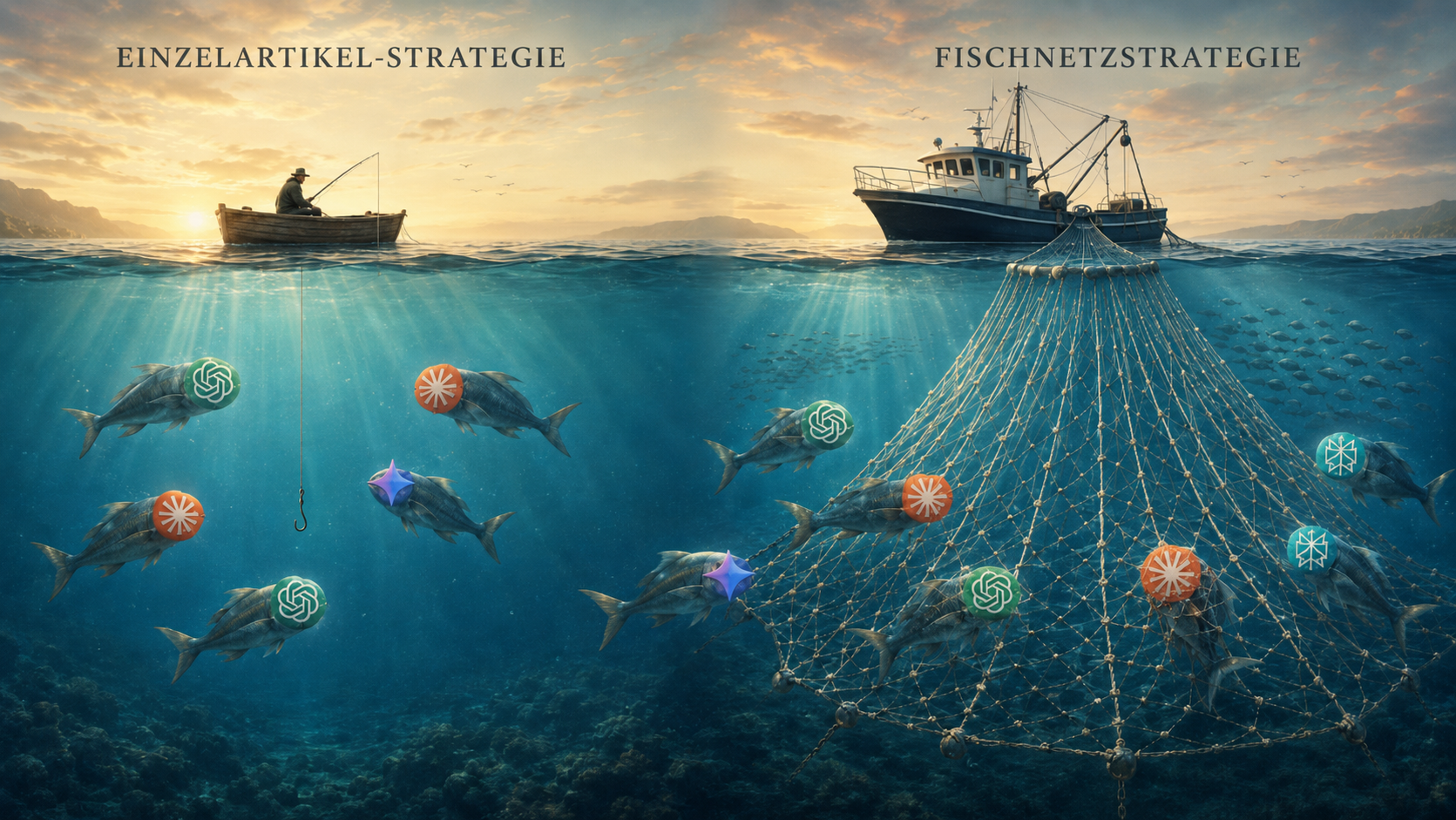
Abbildung 1: Links die Einzelartikel-Strategie mit vereinzelten Treffern, rechts die Fischnetzstrategie mit systematischer KI-Sichtbarkeit durch vernetzte Cluster.
Figure 1: Left: the single-article strategy with scattered hits. Right: the Fishnet Strategy with systematic AI visibility through interconnected clusters.
Die methodische Grundlage der Fischnetzstrategie geht auf die akademische Forschung zu Generative Engine Optimization zurück. Eine peer-reviewed Studie der KDD-2024-Konferenz von Forschenden aus Princeton, Georgia Tech und IIT Delhi zeigt, dass strukturierte GEO-Methoden die Sichtbarkeit eines Inhalts in KI-generierten Antworten um bis zu 40 Prozent steigern können. Die offizielle Princeton-Publikationsseite verzeichnet die Arbeit als KDD-2024-Beitrag und bestätigt die Verankerung von GEO als eigenständige Forschungsdisziplin. Loud & Lexis übersetzt diese akademische Grundlage in eine operative Architektur, die in jedem produzierten Cluster reproduzierbar wirkt.
The methodological foundation of the Fishnet Strategy draws on academic research into Generative Engine Optimisation. A peer-reviewed study presented at the KDD-2024 conference by researchers from Princeton, Georgia Tech and IIT Delhi demonstrates that structured GEO methods can increase the visibility of content in AI-generated responses by up to 40 per cent. The official Princeton publications page records the work as a KDD-2024 contribution and confirms GEO's establishment as an independent research discipline. Loud & lexis translates this academic foundation into an operative architecture that produces reproducible results in every cluster it delivers.
Der ökonomische Hebel hinter der Fischnetzstrategie ist erheblich. Eine McKinsey-Analyse aus dem Oktober 2025 prognostiziert, dass bis 2028 in den USA jährlich 750 Milliarden US-Dollar Konsumausgaben durch AI-powered Search beeinflusst werden, und dokumentiert, dass die Hälfte aller US-Konsumenten KI-gestützte Suche bereits intentional nutzt. Brand-eigene Sites stellen laut McKinsey nur 5 bis 10 Prozent der Quellen, die AI-Search-Antworten referenzieren. Die Fischnetzstrategie ist die methodische Antwort auf diese Asymmetrie: Wer in den verbleibenden 5 bis 10 Prozent landen will, braucht ein vollständiges, dichtes Netz statt einer Handvoll guter Einzelartikel.
The economic leverage behind the Fishnet Strategy is substantial. A McKinsey analysis from October 2025 projects that by 2028, US consumer spending influenced by AI-powered search will reach 750 billion US dollars annually, and documents that half of all US consumers are already using AI-assisted search intentionally. Brand-owned sites account for only 5 to 10 per cent of the sources referenced in AI search responses, according to McKinsey. The Fishnet Strategy is the methodological response to this asymmetry: anyone who wishes to land within that 5 to 10 per cent requires a complete, dense net rather than a handful of strong standalone articles.
Pillar als Knotenpunkt, Sub-Artikel als Stränge
Pillar as Hub, Sub-Articles as Strands
Wie ist eine Pillar-Topical-Struktur für LLM-Optimierung aufgebaut?
How is a Pillar-Topical Structure for LLM Optimisation Built?
Eine Pillar-Topical-Struktur für LLM-Optimierung besteht in der Fischnetzstrategie aus einem Pillar-Artikel von 2.000 bis 4.000 Wörtern als zentralem Themen-Knoten und 8 bis 15 Topical-Artikeln, die jeweils einen Sub-Aspekt vertiefen. Pillar und Topicals sind bidirektional verlinkt, wobei jeder Topical mindestens einen Verweis zurück zum Pillar trägt. Jede H2 im Pillar entspricht einem geplanten Topical-Artikel und kondensiert dessen Kernaussage. Diese Architektur ist kein redaktionelles Schema, sondern ein technisches Antwort-Pattern auf die interne Mechanik moderner KI-Suchsysteme.
A pillar-topical structure for LLM optimisation in the Fishnet Strategy consists of a pillar article of 2,000 to 4,000 words as the central topic hub and 8 to 15 topical articles, each deepening one sub-aspect. Pillar and topicals are bidirectionally linked, with every topical carrying at least one reference back to the pillar. Each H2 in the pillar corresponds to a planned topical article and condenses its core message. This architecture is not an editorial schema but a technical response pattern to the internal mechanics of modern AI search systems.
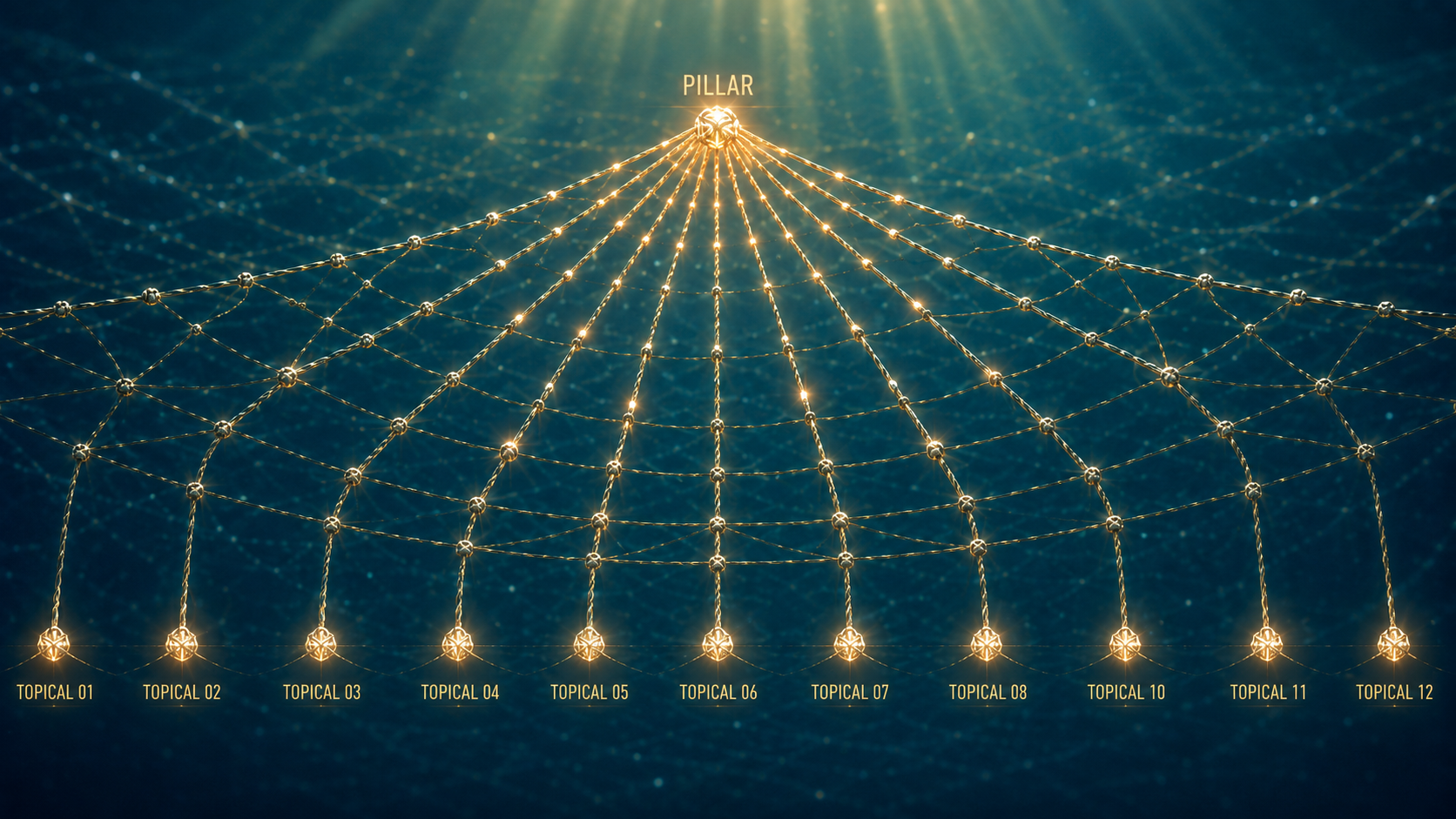
Abbildung 2: Der Pillar-Artikel als leuchtendes Zentrum, bidirektional vernetzte Topical-Artikel als Stränge.
Figure 2: The pillar article as the illuminated hub, with bidirectionally linked topical articles as strands.
Die zentrale Mechanik hinter der Fischnetzstrategie ist Query Fan-Out: Moderne LLM-basierte Antwortmaschinen beantworten User-Prompts nicht direkt, sondern zerlegen sie intern in mehrere parallele Sub-Queries. Search Engine Land beschreibt in seinem Query-Fan-out-Guide, dass Google im AI-Overviews- und AI-Mode-Kontext explizit eine Fan-out-Methodik einsetzt, bei der ein einzelner User-Prompt in mehrere parallele Sub-Searches zerlegt wird, bevor eine synthetisierte Antwort entsteht. Ein zweiter Search-Engine-Land-Guide vertieft diese Mechanik: AI-Engines bewerten Inhalte nicht gegen einen einzelnen Keyword, sondern gegen die volle Menge an Sub-Fragen, die ein Modell beim Beantworten generiert.
The central mechanism behind the Fishnet Strategy is Query Fan-Out: modern LLM-based answer engines do not respond to user prompts directly; instead they decompose them internally into multiple parallel sub-queries. Search Engine Land describes in its Query Fan-Out Guide that Google explicitly employs a fan-out methodology in AI Overviews and AI Mode, whereby a single user prompt is broken into multiple parallel sub-searches before a synthesised answer is produced. A second Search Engine Land guide deepens this mechanic: AI engines evaluate content not against a single keyword but against the full set of sub-questions a model generates when formulating an answer.
Die quantitative Größenordnung dieses Fan-Outs ist erheblich. Eine Analyse von Ekamoira auf Basis von Mike Kings SparkToro-Office-Hours-Daten dokumentiert, dass jeder komplexe AI-Prompt typischerweise in 8 bis 12 parallele Sub-Queries zerlegt wird und nur 25 bis 39 Prozent Überlappung zwischen klassischen Google-Rankings und AI-Search-Citations bestehen. Eine SurferSEO-Studie über fast 174.000 URLs ermittelt zusätzlich eine starke Korrelation von 0,77 zwischen der Anzahl der Fan-out-Sub-Queries, für die eine Seite rankt, und der Wahrscheinlichkeit, in AI Overviews zitiert zu werden. Genau auf diese Korrelation antwortet die Fischnetzstrategie: Jeder Topical-Strang bedient einen Sub-Query.
The quantitative scale of this fan-out is significant. An analysis by Ekamoira based on Mike King's SparkToro Office Hours data documents that every complex AI prompt is typically decomposed into 8 to 12 parallel sub-queries, with only 25 to 39 per cent overlap between classic Google rankings and AI search citations. A SurferSEO study across nearly 174,000 URLs additionally identifies a strong correlation of 0.77 between the number of fan-out sub-queries a page ranks for and the probability of being cited in AI Overviews. The Fishnet Strategy answers precisely this correlation: each topical strand serves one sub-query.
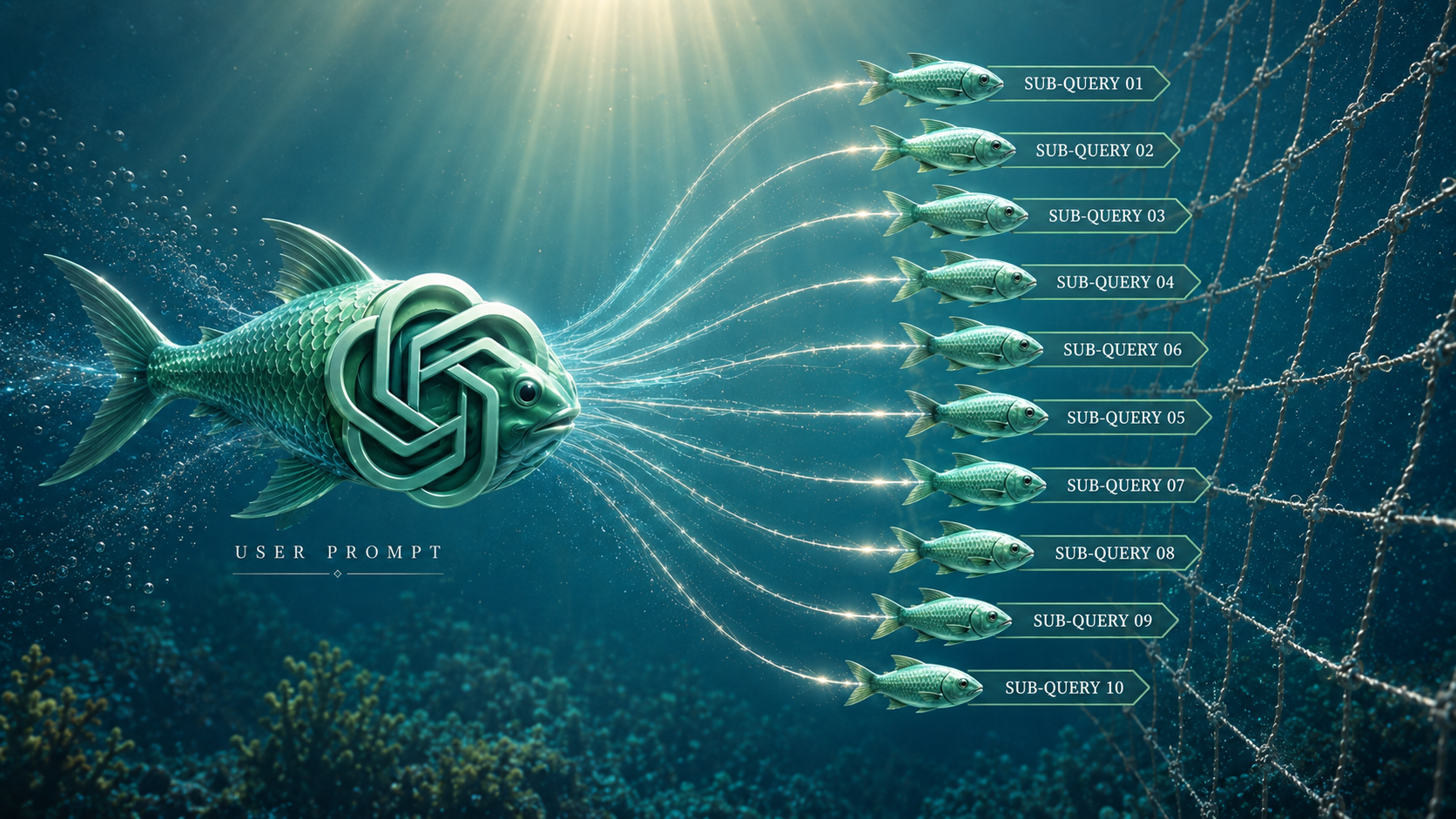
Abbildung 3: Jeder komplexe User-Prompt wird intern in 8 bis 12 Sub-Queries zerlegt. Jede Sub-Query benötigt einen eigenen zitierfähigen Passage-Block.
Figure 3: Every complex user prompt is internally decomposed into 8 to 12 sub-queries. Each sub-query requires its own citable passage block.
Welche Leistungen erbringt interne Verlinkung im Cluster?
What Does Internal Linking Achieve in the Cluster?
Interne Verlinkung im Cluster wirkt in der Fischnetzstrategie als Querverstrebung des Netzes und erhöht laut Sekundärinterpretation der Yext-AI-Citation-Studie 2025 die Citation-Wahrscheinlichkeit um Faktor 2,7. Pillar verweist auf jeden Topical, jeder Topical verweist mindestens einmal zurück zum Pillar. Themenähnliche Topicals sind untereinander verbunden, wenn ein semantischer Pfad zwischen ihnen besteht. Unkontrollierte Querlinks ohne sachliche Grundlage werden vermieden: Sie verheddern das Netz, statt es zu stabilisieren.
Internal linking within the cluster acts in the Fishnet Strategy as cross-bracing of the net, and according to a secondary interpretation of the Yext AI Citation Study 2025, increases the citation probability by a factor of 2.7. The pillar references every topical; every topical references the pillar at least once. Thematically adjacent topicals are connected to one another where a semantic path exists between them. Uncontrolled cross-links without substantive justification are avoided: they tangle the net rather than stabilise it.
Die Belege für die Wirksamkeit verbundener Cluster stammen aus mehreren unabhängigen Auswertungen. Die Yext-Studie von Juli und August 2025 analysierte 6,8 Millionen AI-Citations über ChatGPT, Gemini und Perplexity und stellte fest, dass 86 Prozent der zitierten Quellen aus brand-managed Inhalten stammen, vor allem Websites (44 Prozent) und Listings (42 Prozent). Der ausführliche Yext-Vollreport dokumentiert zusätzlich, dass die Verteilung branchenspezifisch zwischen 47 und 52 Prozent für brand-kontrollierte Quellen variiert.
Evidence for the effectiveness of interconnected clusters comes from several independent analyses. The Yext study from July and August 2025 analysed 6.8 million AI citations across ChatGPT, Gemini and Perplexity and found that 86 per cent of cited sources come from brand-managed content, primarily websites (44 per cent) and listings (42 per cent). The detailed Yext full report additionally documents that the distribution varies by industry between 47 and 52 per cent for brand-controlled sources.
Branchen-Auswertungen interpretieren diese Yext-Daten zu konkreten Cluster-Effekten weiter. Eine Wellows-Analyse 2026 berichtet unter Verweis auf die Yext-Daten, dass Sites mit Topic-Clustern 3,2-fach mehr AI-Citations erreichen als Standalone-Seiten und dass die 86-Prozent-Schwelle besonders deutlich bei Sites mit fünf oder mehr vernetzten Seiten zum Thema greift. Whitehat-SEO-Auswertungen 2026 ergänzen, dass geclusterte Inhalte gegenüber Standalone-Beiträgen rund 30 Prozent mehr Organic Traffic generieren und Rankings 2,5-fach länger halten. Für die Fischnetzstrategie ist das die quantitative Begründung der bidirektionalen Verlinkung: Sie ist keine stilistische Empfehlung, sondern ein messbarer Citation-Hebel.
Industry analyses extrapolate these Yext figures into concrete cluster effects. A Wellows analysis from 2026 reports, referencing the Yext data, that sites with topic clusters achieve 3.2 times more AI citations than standalone pages, and that the 86 per cent threshold is particularly pronounced for sites with five or more interconnected pages on the topic. Whitehat SEO analyses from 2026 add that clustered content generates around 30 per cent more organic traffic than standalone content and sustains rankings 2.5 times longer. For the Fishnet Strategy, this is the quantitative justification for bidirectional linking: it is not a stylistic recommendation but a measurable citation lever.
Der Similarity-Korridor: Embedding-Analyse als mathematische Entscheidungsgrundlage
The Similarity Corridor: Embedding Analysis as Mathematical Decision Basis
Was ist die Content-Similarity-Analyse als GEO-Methodik?
What is the Content-Similarity Analysis as GEO Methodology?
Die Content-Similarity-Analyse ist die 2026 von Tobias Peschke bei Loud & Lexis entwickelte GEO-Methodik zur Embedding-basierten Vermessung des Themenraums: Die Methode berechnet für jeden Artikel eines Bestands einen Vektor im multidimensionalen Bedeutungsraum und gibt die Abstände zwischen Artikeln als Zahlenwert aus. Loud & Lexis nutzt diese Methodik um den gesamten Content-Bestand eines Kunden zu vergleichen. Das Ergebnis ist eine Karte: Welche Artikel decken welche semantischen Regionen ab, wo gibt es Lücken, wo gibt es Überlappungen. Vor jedem neuen Artikel wird diese Karte als Cross-Check abgefragt.
The Content-Similarity Analysis is the GEO methodology developed by Tobias Peschke at Loud & Lexis in 2026 for embedding-based measurement of the topic space: the method calculates a vector in multidimensional semantic space for every article in a content inventory and outputs the distances between articles as a numerical value. Loud & lexis uses this methodology to compare a client's entire content inventory. The result is a map: which articles cover which semantic regions, where are the gaps, where are the overlaps. Before every new article, this map is consulted as a cross-check.
Die fachliche Grundlage der Content-Similarity-Analyse liegt in der RAG-Architektur (Retrieval-Augmented Generation) der modernen LLM-Antwortmaschinen. IBM beschreibt RAG als Verfahren, bei dem Inhalte über ein Embedding-Modell als Vektoren in einem multidimensionalen Raum repräsentiert werden, wobei Inhalte mit ähnlicher Bedeutung räumlich nahe beieinander liegen. NVIDIA ergänzt diese Beschreibung durch die Definition von RAG als Architekturmuster, bei dem ein LLM mit Embedding- und Reranker-Modellen erweitert wird, die kontinuierlich maschinen-lesbare Vektor-Indices über das Wissensfeld pflegen. Wer Content für LLMs optimiert, optimiert in genau diesem Vektorraum, nicht in einer Keyword-Liste.
The technical foundation of the Content-Similarity Analysis lies in the RAG (Retrieval-Augmented Generation) architecture of modern LLM answer engines. IBM describes RAG as a process in which content is represented as vectors in a multidimensional space via an embedding model, with content of similar meaning positioned spatially close together. NVIDIA adds to this description by defining RAG as an architecture pattern in which an LLM is augmented with embedding and reranker models that continuously maintain machine-readable vector indices of the knowledge domain. Anyone optimising content for LLMs is optimising within exactly this vector space, not a keyword list.
Wann wird Content-Überlappung im GEO-Kontext schädlich?
When Does Content Overlap Become Harmful in the GEO Context?
Content-Überlappung wird in der Fischnetzstrategie schädlich, sobald die semantische Nähe zwischen zwei Artikeln so hoch ist, dass beide im RAG-Index dieselbe Retrieval-Position besetzen. In diesem Fall konkurrieren die Artikel intern um Zitationsslots, statt sich zu ergänzen, und keiner der beiden wird zuverlässig ausgewählt. Loud & Lexis identifiziert dieses Risiko vor der Publikation durch eine zweistufige Embedding-Prüfung gegen Geschwister-Artikel im Cluster und gegen den Gesamtbestand. Erst nach grünem Licht beider Ebenen geht ein Artikel in Produktion.
Content overlap becomes detrimental in the Fishnet Strategy as soon as the semantic proximity between two articles is high enough that both occupy the same retrieval position in the RAG index. In this case, the articles compete internally for citation slots rather than complementing one another, and neither is reliably selected. Loud & lexis identifies this risk before publication through a two-stage embedding check against sibling articles in the cluster and against the full inventory. An article only enters production once both levels have returned a positive result.
Die wissenschaftlichen Belege für dieses Phänomen sind belastbar. Eine 2025 publizierte arXiv-Studie internationaler Universitäten dokumentiert, dass Embedding-basierte Retrieval-Systeme typischerweise Inhalte zurückliefern, die formal semantisch ähnlich sind, aber inhaltlich an der eigentlichen Nutzerintention vorbeigehen. Die SlimRAG-Forschungsarbeit aus 2025 identifiziert Retrieval-Redundanz als grundlegendes Bottleneck von RAG-Pipelines: Inhalte, die im Embedding-Raum zu nahe beieinander liegen, erzeugen überlappende, schlecht abgegrenzte Retrieval-Mengen, die LLMs in Antworten nicht eindeutig zitieren können. Genau diesen Defekt verhindert die Similarity-Prüfung in der Fischnetzstrategie.
The scientific evidence for this phenomenon is robust. An arXiv study published in 2025 by researchers from international universities documents that embedding-based retrieval systems typically return content that is formally semantically similar but misses the actual user intent. The SlimRAG research paper from 2025 identifies retrieval redundancy as a fundamental bottleneck in RAG pipelines: content that lies too close together in embedding space generates overlapping, poorly differentiated retrieval sets that LLMs cannot cite unambiguously in responses. The similarity check in the Fishnet Strategy prevents exactly this defect.

Abbildung 4: Zu hohe semantische Nähe zwischen Artikel A und B führt zu RAG-Kannibalisierung. Die Content-Similarity-Analyse identifiziert dieses Risiko vor der Publikation.
Figure 4: Excessive semantic proximity between Article A and B leads to RAG cannibalization. The Content-Similarity Analysis identifies this risk before publication.
Wie unterscheidet sich Embedding-basierte Content-Architektur von Keyword-Architektur?
How Does Embedding-Based Content Architecture Differ from Keyword Architecture?
Embedding-basierte Content-Architektur unterscheidet sich von Keyword-Architektur darin, dass sie die Bedeutungs-Position eines Inhalts im Vektorraum statt seine Übereinstimmung mit einer Wortliste optimiert. Ein Keyword-orientierter Artikel passt zu Suchanfragen, die identische oder ähnliche Wörter verwenden, ein Embedding-orientierter Artikel passt zu allen Anfragen, die semantisch in der Region des Artikels liegen, unabhängig von der Wortwahl. Bei Loud & Lexis ersetzt die Embedding-Logik den Keyword-Reflex, weil LLMs intern in genau dieser Vektor-Logik retrieven, nicht in Wortlisten.
Embedding-based content architecture differs from keyword architecture in that it optimises the semantic position of content in vector space rather than its alignment with a word list. A keyword-oriented article matches queries using identical or similar words; an embedding-oriented article matches all queries that lie semantically in the article's region, regardless of word choice. At Loud & Lexis, embedding logic replaces the keyword reflex because LLMs retrieve internally in exactly this vector logic, not in word lists.
Die Wahl des Embedding-Modells beeinflusst die Aussagekraft der Similarity-Analyse messbar. Eine 2025 in Springer Nature publizierte Vergleichsstudie über 22 Embedding-Modelle bestätigt, dass die Wahl des Embedding-Modells und die Domain-Anpassung signifikante Auswirkungen auf die semantische Präzision der Retrieval-Ergebnisse haben, besonders bei komplexen Multi-Hop-Reasoning-Tasks. Aus diesem Grund arbeitet Loud & Lexis nicht mit einem generischen Off-the-shelf-Modell, sondern mit einem proprietär trainierten LLM, das auf den jeweiligen Themen- und Branchen-Kontext eines Kunden abgestimmt ist.
The choice of embedding model measurably influences the analytical power of the similarity analysis. A comparative study of 22 embedding models published in Springer Nature in 2025 confirms that the choice of embedding model and domain adaptation have significant effects on the semantic precision of retrieval results, particularly for complex multi-hop reasoning tasks. For this reason, Loud & Lexis does not work with a generic off-the-shelf model but with a proprietary trained LLM calibrated to each client's specific topic and industry context.
Der Similarity-Korridor lässt sich als Tabelle abbilden:
| Similarity zwischen Cluster-Artikeln | Wirkung im RAG-Index | Konsequenz für die Fischnetzstrategie |
|---|---|---|
| Zu hoch (sehr nah) | Kannibalisierung: beide Artikel konkurrieren um denselben Retrieval-Slot | Artikel zusammenführen oder einen der beiden differenzieren |
| Im Korridor | Gegenseitige Verstärkung: Cluster signalisiert Topical Authority | Publikation und bidirektionale Verlinkung |
| Zu niedrig (zu fern) | Lücke im Themenraum: weitere Sub-Aspekte unterabgedeckt | Zusätzlichen Topical-Strang zwischen die Artikel knüpfen |
| Similarity between cluster articles | Effect in the RAG index | Consequence for the Fishnet Strategy |
|---|---|---|
| Too high (very close) | Cannibalisation: both articles compete for the same retrieval slot | Merge the articles or differentiate one of them |
| Within the corridor | Mutual reinforcement: cluster signals topical authority | Publication and bidirectional linking |
| Too low (too distant) | Gap in the topic space: further sub-aspects underrepresented | Insert an additional topical strand between the articles |
LLMs als symbolische Fische in besonders gut gewebte Netze
LLMs as Symbolic Fish in Well-Woven Nets
Wenn das Netz vollständig und differenziert ist, gehen LLMs bevorzugt darin ein. Diese Bevorzugung ist kein metaphorisches Bild, sondern ein messbares Muster in der Citation-Verteilung moderner KI-Suchsysteme. ZipTie-Daten zeigen, dass Topic-Cluster strukturell besser für AI-Citations geeignet sind als Standalone-Seiten, dass 80 Prozent der LLM-Citations von Pages stammen, die in Googles klassischer Top-100 nicht einmal ranken, und dass Fan-out-Sub-Queries 51 Prozent aller AI-Citations ausmachen. Das Netz fängt also dort, wo die klassische Suche längst nichts mehr findet.
When the net is complete and well-differentiated, LLMs preferentially enter it. This preference is not a metaphor but a measurable pattern in the citation distribution of modern AI search systems. ZipTie data show that topic clusters are structurally better suited for AI citations than standalone pages, that 80 per cent of LLM citations come from pages that do not even rank in Google's classic top 100, and that fan-out sub-queries account for 51 per cent of all AI citations. The net catches where classic search long since finds nothing.
Die Mechanik der LLM-Citation-Auswahl ist mittlerweile gut beschrieben. Discovered Labs skizziert die LLM-Retrieval-Mechanik anhand dreier Engineering-Prinzipien: semantische Relevanz über Vektor-Embeddings, strukturelle Klarheit für Machine-Parsing und Entity-Validation über Consensus-Signale. Wellows ergänzt für 2026, dass Topic-Cluster die Wahrscheinlichkeit erhöhen, von einem LLM als kanonische Quelle gewählt zu werden, weil Pillar plus Cluster-Pages Retrieval-Systemen helfen, eine definitive Page der Site auszuwählen, statt Authority über mehrere überlappende Beiträge zu splitten. Die Fischnetzstrategie wirkt in beide Richtungen: Sie liefert den Cluster und vermeidet das Splitting durch die Embedding-Validierung.
The mechanics of LLM citation selection are now well documented. Discovered Labs outlines the LLM retrieval mechanics around three engineering principles: semantic relevance via vector embeddings, structural clarity for machine parsing, and entity validation via consensus signals. Wellows adds for 2026 that topic clusters increase the probability of being selected by an LLM as the canonical source, because pillar plus cluster pages help retrieval systems identify a definitive page on the site rather than splitting authority across several overlapping posts. The Fishnet Strategy works in both directions: it delivers the cluster and avoids the splitting through embedding validation.
Die Citation-Wahrscheinlichkeit eines Cluster-Artikels wird zusätzlich durch Brand-Authority-Signale getrieben. Eine Wellows-Auswertung von über 282 Millionen LLM-Citations identifiziert das Markensuchvolumen (Brand Search Volume) mit einer Korrelation von 0,334 als stärksten Einzelprädiktor für LLM-Citations und stellt fest, dass Sites mit Präsenz auf vier oder mehr AI-Plattformen 2,8-fach wahrscheinlicher in ChatGPT-Antworten zitiert werden. Wellows beschreibt zusätzlich für 2026, dass LLM-Citations vor allem extrahierbare, verifizierbare und semantisch präzise Inhalte bevorzugen und dass die Frequenz, mit der eine Seite aktualisiert wird, ein eigenständiger Citation-Treiber für dynamische Themen ist. Backlinks zeigen in derselben Auswertung nur eine schwache Korrelation, eine bemerkenswerte Differenz zur klassischen SEO-Logik.
The citation probability of a cluster article is additionally driven by brand authority signals. A Wellows analysis of over 282 million LLM citations identifies brand search volume as the strongest single predictor of LLM citations, with a correlation of 0.334, and finds that sites with a presence on four or more AI platforms are 2.8 times more likely to be cited in ChatGPT responses. Wellows adds for 2026 that LLM citations favour content that is extractable, verifiable and semantically precise, and that the frequency with which a page is updated is an independent citation driver for dynamic topics. Backlinks show only a weak correlation in the same analysis — a remarkable divergence from classic SEO logic.
Strukturierte Trust-Signale verstärken den Citation-Effekt der Fischnetzstrategie zusätzlich. Branchen-Berichte unter Verweis auf Google I/O 2026 nennen für Pages mit Stacked Schema (Article plus Author plus Breadcrumb plus Entity-Connections) eine bis zu 3,1-fache Erhöhung der AI-Citation-Frequenz gegenüber unmarkierten Inhalten, mit zusätzlichen 2,6-fachen Citations für Article-Schema mit Author- und Publisher-Daten laut Reuters-Institute-Auswertung. ALMCorp argumentiert für 2026 ergänzend, dass verschachtelte Schema-Strukturen aus Article-, Breadcrumb- und Person-Markup mit Wikidata-Disambiguierung den semantischen Kontext liefern, den AI-Systeme zuverlässig parsen und zitieren können.
Structured trust signals additionally amplify the citation effect of the Fishnet Strategy. Industry reports referencing Google I/O 2026 cite up to a 3.1-fold increase in AI citation frequency for pages with stacked schema (Article plus Author plus Breadcrumb plus Entity-Connections) compared to unmarked content, with an additional 2.6-fold increase for Article schema with Author and Publisher data according to the Reuters Institute analysis. ALMCorp argues for 2026 that nested schema structures combining Article, Breadcrumb and Person markup with Wikidata disambiguation provide the semantic context that AI systems can reliably parse and cite.
Eine weitere Citation-Stellschraube ist die Faktendichte zitierfähiger Aussagen im Artikel selbst. Onely zeigt unter Verweis auf Airops-Daten, dass AI Overviews 6,5-mal häufiger über Third-Party-Sources zitieren als über die eigene Brand-Domain und dass quantitative Claims rund 40 Prozent höhere Citation-Rates erreichen als qualitative Aussagen. Die Fischnetzstrategie zieht daraus zwei Konsequenzen: Jeder Cluster-Artikel arbeitet mit konkreten Zahlen, nicht mit qualitativen Adjektiven, und externe Quellen werden bewusst integriert, statt nur die eigenen Inhalte zu zitieren.
A further citation lever is the density of citable claims within the article itself. Onely shows, referencing Airops data, that AI Overviews cite via third-party sources 6.5 times more frequently than via a brand's own domain, and that quantitative claims achieve around 40 per cent higher citation rates than qualitative statements. The Fishnet Strategy draws two conclusions from this: every cluster article works with concrete figures rather than qualitative adjectives, and external sources are deliberately integrated rather than citing only the brand's own content.
Der kumulative Vorsprung einer dichten Netzarchitektur entsteht aus der Summe dieser Effekte: mehr abgedeckte Sub-Queries, weniger interne Konkurrenz, höhere Brand-Authority-Signale, stärkere Trust-Layer. Jeder einzelne Effekt wirkt für sich, in Summe entstehen kompounding gains. Wer das Netz früh spannt, baut über Monate einen Vorsprung auf, der durch nachträgliche Einzelartikel nicht mehr aufzuholen ist.
The cumulative advantage of a dense net architecture arises from the sum of these effects: more sub-queries covered, less internal competition, stronger brand authority signals, more powerful trust layers. Each individual effect works on its own; in combination they generate compounding gains. Whoever spans the net early builds a lead over months that subsequent standalone articles cannot close.
Wie Loud & Lexis die Fischnetzstrategie operativ umsetzt
How Loud & Lexis Operationally Implements the Fishnet Strategy
Die operative Umsetzung der Fischnetzstrategie erfolgt bei Loud & Lexis im Rahmen unserer GEO Beratung, die sechs produktisierte Services zu einem Workflow verbindet. Service 01 (AI Content Cluster) liefert das eigentliche Netz: einen Pillar-Artikel und bis zu 15 Topical-Artikel mit bidirektionaler Verlinkung und automatisierter Qualitätskontrolle gegen über 100 Regelprüfpunkte. Service 06 (Content-Similarity-Analyse) ist die Vermessung des Netzes und der Cross-Check vor jeder neuen Publikation, betrieben mit unserem proprietär trainierten LLM. Beide Services greifen ineinander: Ohne Similarity-Prüfung wäre der Cluster blind, ohne Cluster wäre die Prüfung gegenstandslos.
The operative implementation of the Fishnet Strategy at Loud & Lexis takes place within our GEO consultancy, which combines six productised services into one workflow. Service 01 (AI Content Cluster) delivers the net itself: a pillar article and up to 15 topical articles with bidirectional linking and automated quality control against over 100 rule checks. Service 06 (Content-Similarity Analysis) measures the net and provides the cross-check before every new publication, operated with our proprietary trained LLM. Both services interlock: without the similarity check the cluster would be blind; without the cluster the check would have no object.
Die Mess-Schicht über dem Netz bildet Service 04 (AI Visibility Monitoring) auf Basis unserer offiziellen Mess-Partnerschaft mit Promptwatch. Statt Keyword-Rankings tracken wir persona-basierte Prompts gegen die vier dominanten LLM-Plattformen. Die Plattform-Verteilung im AI-Chatbot-Markt zeigt aktuelle Similarweb-Daten für Anfang 2026 deutlich: ChatGPT hält rund 79 Prozent des globalen GenAI-Web-Traffics (September 2025), Gemini wuchs zwischen April und September 2025 um 157 Prozent auf 1,1 Milliarden monatliche Visits, Perplexity steht bei 170 Millionen, Claude bei 157 Millionen monatlichen Visits. AI-Plattform-Visits stiegen Januar 2025 bis Januar 2026 um 28,6 Prozent, während Referrals zu externen Sites stagnieren. Wer in diesen Plattformen sichtbar werden will, misst nicht Klicks, sondern Citations.
The measurement layer above the net is formed by Service 04 (AI Visibility Monitoring), based on our official measurement partnership with Promptwatch. Instead of keyword rankings we track persona-based prompts against the four dominant LLM platforms. Current Similarweb data on the AI chatbot market for early 2026 are clear: ChatGPT holds around 79 per cent of global GenAI web traffic (September 2025), Gemini grew 157 per cent between April and September 2025 to reach 1.1 billion monthly visits, Perplexity stands at 170 million and Claude at 157 million monthly visits. AI platform visits grew 28.6 per cent from January 2025 to January 2026, whilst referrals to external sites stagnate. Anyone seeking visibility on these platforms measures citations, not clicks.
Der ökonomische Effekt der Fischnetzstrategie zeigt sich in den Conversion-Daten des AI-Traffics. Eine Analyse von Superprompt über 12 Millionen Website-Visits über mehr als 350 Unternehmen kam 2025 zum Ergebnis, dass AI-Search-Traffic mit durchschnittlich 14,2 Prozent Conversion-Rate etwa fünfmal so gut konvertiert wie klassischer Google-Organic-Traffic mit 2,8 Prozent. ChatGPT-Conversion liegt bei 15,9 Prozent, Claude bei 16,8 Prozent, Perplexity bei 10,5 Prozent. AI-Search-Queries sind mit durchschnittlich 12,3 Wörtern erheblich länger und spezifischer als Google-Queries mit 2,8 Wörtern. Eine Sammlung weiterer Branchen-Studien bestätigt diesen Effekt: Ahrefs misst 23-fach, Semrush 4,4-fach, weitere Studien 5- bis 27-fach höhere Conversion-Raten gegenüber klassischer Organic-Suche.
The economic effect of the Fishnet Strategy is visible in the conversion data of AI traffic. An analysis by Superprompt covering 12 million website visits across more than 350 companies concluded in 2025 that AI search traffic converts at an average rate of 14.2 per cent — approximately five times better than classic Google organic traffic at 2.8 per cent. ChatGPT conversion stands at 15.9 per cent, Claude at 16.8 per cent, Perplexity at 10.5 per cent. AI search queries average 12.3 words, considerably longer and more specific than Google queries at 2.8 words. A compilation of further industry studies confirms this effect: Ahrefs measures a 23-fold increase, Semrush a 4.4-fold increase, and further studies between 5- and 27-fold higher conversion rates compared to classic organic search.
Die Sequenzierung der Services hängt von der Baseline-Lage des Kunden ab. Bei einem Bestand mit 50, 100 oder 200 Artikeln und schwachem KI-Auftritt beginnen wir mit dem Similarity-Audit als Diagnose, gefolgt von Blog-to-AI Upcycling als zentralem Hebel und Service Monitoring als Mess-Schicht. Neue Cluster und AI Trust Layern mit Author Pages, Trust Pages, Case Study Pages als JSON-LD folgen, sobald der Bestand sauber ist. Bei kleinem oder neuem Bestand drehen wir die Reihenfolge um: Erst Fundament und Trust-Layer, dann Cluster, dann Bereinigungs-Disziplinen, sobald genug Bestand existiert.
The sequencing of services depends on the client's baseline position. For an inventory of 50, 100 or 200 articles with weak AI presence, we begin with the similarity audit as diagnosis, followed by Blog-to-AI Upcycling as the central lever and service monitoring as the measurement layer. New clusters and AI trust layers — Author Pages, Trust Pages, Case Study Pages as JSON-LD — follow once the inventory is clean. For small or new inventories, we reverse the order: foundation and trust layer first, then clusters, then the cleansing disciplines once sufficient inventory exists.
Worauf Sie bei der Auswahl einer GEO-Agentur achten sollten
What to Look for When Choosing a GEO Agency
Eine GEO-Agentur ohne nachweisbare Cluster-Methodik liefert in der KI-Suche keine messbaren Ergebnisse. Branchenmedien berichten unter Verweis auf McKinsey-Daten, dass aktuell rund die Hälfte aller Konsumenten AI-powered Search aktiv nutzt und dass eigene Markenkanäle nur 5 bis 10 Prozent der Quellen ausmachen, aus denen AI-Antworten generiert werden. In diesem Marktumfeld entscheidet die methodische Tiefe einer Agentur darüber, ob ein Kunde in den 5 bis 10 Prozent landet oder nicht. Generische SEO-Erweiterungen mit GEO-Etikett genügen dafür nicht.
A GEO agency without a demonstrable cluster methodology delivers no measurable results in AI search. Industry media report, citing McKinsey data, that approximately half of all consumers are now actively using AI-powered search and that brand-owned channels account for only 5 to 10 per cent of the sources from which AI responses are generated. In this market environment, the methodological depth of an agency determines whether a client lands within that 5 to 10 per cent or not. Generic SEO extensions wearing a GEO label are insufficient for this purpose.
Die folgende Checkliste fasst die Auswahlkriterien für eine Agentur zusammen, die im Sinne der Fischnetzstrategie arbeitet:
- Cluster-Architektur statt Einzelartikel. Liefert die Agentur Pillar-plus-Topicals mit dokumentierter bidirektionaler Verlinkung, oder produziert sie weiterhin Einzelartikel ohne Netz?
- Embedding-basierte Similarity-Analyse. Wird vor jeder Publikation der semantische Abstand zum Bestand mathematisch geprüft, oder beruht die Redaktionsplanung weiterhin auf Bauchgefühl?
- Persona-basiertes Prompt-Tracking. Misst die Agentur reale Persona-Prompts gegen die vier dominanten LLMs, oder bleibt sie bei Keyword-Rankings?
- AI Trust Architecture als JSON-LD. Werden Author Pages, Trust Pages und Case Studies als maschinenlesbare Schema-Strukturen aufgebaut, oder als PDFs, die für LLMs unsichtbar sind?
- Technische GEO-Basis. Sind GPTBot, ClaudeBot und PerplexityBot konfiguriert, ist eine llms.txt vorhanden, ist JavaScript-Rendering AI-tauglich?
- Methodische Eigenständigkeit. Verwendet die Agentur eine eigene operative Logik wie die Fischnetzstrategie, oder repliziert sie generische GEO-Vokabeln?
- Cluster architecture over standalone articles. Does the agency deliver pillar-plus-topicals with documented bidirectional linking, or does it continue producing standalone articles without a net?
- Embedding-based similarity analysis. Is the semantic distance to the existing inventory mathematically verified before every publication, or does editorial planning still rest on intuition?
- Persona-based prompt tracking. Does the agency measure real persona prompts against the four dominant LLMs, or does it remain with keyword rankings?
- AI Trust Architecture as JSON-LD. Are Author Pages, Trust Pages and Case Studies built as machine-readable schema structures, or as PDFs invisible to LLMs?
- Technical GEO foundation. Are GPTBot, ClaudeBot and PerplexityBot configured? Is an llms.txt present? Is JavaScript rendering AI-compatible?
- Methodological independence. Does the agency use its own operative logic such as the Fishnet Strategy, or does it replicate generic GEO vocabulary?
Aktuelle Similarweb-Auswertungen für Anfang 2026 zeigen darüber hinaus eine Verschiebung der Marktanteile: ChatGPT 64,5 Prozent (sinkend von quasi-Monopolposition), Gemini 18,2 Prozent (verdoppelt seit Mitte 2025), Grok 3,4 Prozent, Claude 2,0 Prozent, Copilot 1,1 Prozent. Eine GEO-Agentur, die nur eine dieser Plattformen messbar adressiert, deckt strukturell weniger als die Hälfte des Marktes ab. Branchen-Auswertungen 2026 dokumentieren ergänzend, dass dichte Topic-Cluster für B2B-SaaS-Marken inzwischen Voraussetzung für glaubwürdige E-E-A-T-Signale gegenüber LLMs geworden sind, mit Pillars von 15 oder mehr verbundenen Cluster-Artikeln als Schwelle für genuine Topical Authority.
Current Similarweb analyses for early 2026 additionally show a shift in market shares: ChatGPT 64.5 per cent (declining from a near-monopoly position), Gemini 18.2 per cent (doubled since mid-2025), Grok 3.4 per cent, Claude 2.0 per cent, Copilot 1.1 per cent. A GEO agency that measurably addresses only one of these platforms structurally covers less than half the market. Industry analyses from 2026 additionally document that dense topic clusters have now become a prerequisite for credible E-E-A-T signals towards LLMs for B2B SaaS brands, with pillars of 15 or more connected cluster articles as the threshold for genuine topical authority.
Wie gut ist Ihr Content-Netz gespannt?
How Well is Your Content Net Spanned?
Buchen Sie ein Strategiegespräch mit Tobias Peschke. Wir schauen gemeinsam, wie Ihr Content-Netz heute aufgestellt ist und welche Hebel die größte Wirkung auf Ihre KI-Sichtbarkeit haben.
Book a strategy call with Tobias Peschke. We'll look at how your content network is currently positioned and which levers have the greatest impact on your AI visibility.
Strategiegespräch buchen Book a Strategy CallHäufige Fragen zur Fischnetzstrategie
Frequently Asked Questions
GEO ist kein verschwindender Hype, sondern eine sich konsolidierende Disziplin. Gartner verortet Generative AI im Hype Cycle 2025 im Trough of Disillusionment, der Phase, in der Unternehmen Potenzial und Grenzen einer Technologie realistisch einordnen. Gartner prognostiziert gleichzeitig, dass bis 2028 über 95 Prozent der Unternehmen GenAI in produktiven Anwendungen nutzen werden. Genau diese Konsolidierungsphase ist der strategische Einstiegszeitpunkt für die Fischnetzstrategie: Nicht in der Hype-Spitze, sondern in der Realisierungsphase wird Sichtbarkeit gebaut, die langfristig trägt.
GEO is not a disappearing hype but a consolidating discipline. Gartner places Generative AI in the 2025 Hype Cycle within the Trough of Disillusionment — the phase in which companies realistically assess the potential and limits of a technology. Gartner simultaneously projects that by 2028, over 95 per cent of companies will be using GenAI in productive applications. This consolidation phase is precisely the strategic entry point for the Fishnet Strategy: not at the hype peak, but in the realisation phase is where visibility is built that endures.
Ja, die Fischnetzstrategie reduziert das Risiko falscher Citations strukturell. Eine 2025 in Nature Communications publizierte Stanford-Studie analysierte sieben Sprachmodelle auf 58.000 Statement-Quellen-Paaren und stellte fest, dass zwischen 50 und 90 Prozent der LLM-Antworten von ihren zitierten Quellen nicht vollständig gestützt oder sogar widersprochen werden. Genau deshalb arbeitet die Fischnetzstrategie mit atomaren, zitierfähigen Passage-Blöcken: Eine eindeutig extrahierbare Aussage mit klarer Quelle wird seltener fehlinterpretiert als ein verschachtelter Argumentationsbogen. Strukturelle Klarheit ist die Antwort auf die Citation-Unzuverlässigkeit der Modelle.
Yes, the Fishnet Strategy structurally reduces the risk of incorrect citations. A study published in Nature Communications in 2025 from Stanford analysed seven language models on 58,000 statement-source pairs and found that between 50 and 90 per cent of LLM responses are not fully supported by — or even contradict — their cited sources. This is precisely why the Fishnet Strategy works with atomic, citable passage blocks: a clearly extractable statement with a clear source is less frequently misinterpreted than a nested line of argument. Structural clarity is the response to the citation unreliability of the models.
Nein, GEO unterscheidet sich strukturell, auch wenn Überlappungen existieren. Der Search-Engine-Journal-Jahresrückblick 2025 fasst zusammen, dass GEO 2025 Mainstream geworden ist, klare Abgrenzungen zur klassischen SEO bisher aber teilweise gescheitert sind. Eine differenzierte Branchen-Skepsis aus dem Umfeld der AIVO-Plattform schätzt 2026, dass GEO etwa zu 40 Prozent aus genuin neuer Mechanik (extraktions-orientierte Struktur, Outbound-Link-Logik, Prompt-Research, Embedding-Verfahren) und zu 60 Prozent aus klassischer SEO mit neuem Etikett besteht. Die Fischnetzstrategie nutzt die 40 Prozent neue Mechanik konsequent: Embedding-Validierung und Query-Fan-out-Coverage sind in klassischer SEO nicht abbildbar.
No, GEO differs structurally, even where overlaps exist. The Search Engine Journal 2025 year review summarises that GEO went mainstream in 2025 but that clear demarcations from classic SEO have partly proved elusive. A nuanced industry view from the AIVO platform community estimates for 2026 that GEO consists of approximately 40 per cent genuinely new mechanics (extraction-oriented structure, outbound link logic, prompt research, embedding methods) and 60 per cent classic SEO with a new label. The Fishnet Strategy uses the 40 per cent new mechanics consistently: embedding validation and query fan-out coverage are not replicable in classic SEO.
Ja, der Wert entsteht nicht aus Referrals, sondern aus Citations und höherer Conversion-Rate des verbleibenden Traffics. Search Engine Land berichtet 2026 unter Verweis auf Cloudflare-Daten, dass GPTBot rund 1.500 Pages crawlt für jeden einzelnen Visitor, den ChatGPT an externe Sites zurücksendet. Gleichzeitig zeigt die Superprompt-Analyse von 12 Millionen Visits eine fünffach höhere Conversion-Rate (14,2 Prozent vs. 2,8 Prozent Google) für AI-Traffic. Wer Citations baut, baut Markenpräsenz in der Antwort selbst, unabhängig vom Klick: Die Fischnetzstrategie zielt genau auf diese Antwort-Sichtbarkeit, nicht auf Referral-Volumen.
Yes — the value does not arise from referrals but from citations and the higher conversion rate of the remaining traffic. Search Engine Land reports in 2026, citing Cloudflare data, that GPTBot crawls around 1,500 pages for every single visitor that ChatGPT sends back to external sites. At the same time, the Superprompt analysis of 12 million visits shows a fivefold higher conversion rate (14.2 per cent vs 2.8 per cent for Google) for AI traffic. Whoever builds citations builds brand presence within the answer itself, independently of the click: the Fishnet Strategy aims precisely at this answer-level visibility, not at referral volume.
Ein Pillar in der Fischnetzstrategie hat bei Loud & Lexis bis zu 15 Topical-Artikel, wobei der Schwellenwert für genuine Topical Authority bei mindestens fünf vernetzten Seiten liegt. Die Yext-Daten 2025 belegen die 86-Prozent-Citation-Schwelle für Sites mit fünf oder mehr verbundenen Seiten zum Thema (sekundäre Interpretation), die Studienlage spricht eindeutig für dichte Cluster ab dieser Schwelle. Die exakte Anzahl in einem Cluster hängt von der semantischen Breite des Themenfeldes ab und wird vor der Produktion durch unsere Content-Similarity-Analyse validiert. Mehr als 15 Topicals pro Pillar deuten meistens darauf hin, dass das Themenfeld in zwei Pillars aufgeteilt werden sollte.
A pillar in the Fishnet Strategy at Loud & Lexis has up to 15 topical articles, with the threshold for genuine topical authority lying at a minimum of five interconnected pages. The Yext 2025 data support the 86 per cent citation threshold for sites with five or more connected pages on the topic (secondary interpretation), and the evidence clearly favours dense clusters above this threshold. The exact number in a cluster depends on the semantic breadth of the topic area and is validated by our Content-Similarity Analysis before production. More than 15 topicals per pillar usually indicates that the topic area should be split into two pillars.
Die Content-Similarity-Analyse von Loud & Lexis verhindert Kannibalisierung von mehreren Blog-Artikeln durch eine zweistufige Embedding-Prüfung vor jeder Publikation. Auf der ersten Stufe wird der geplante Artikel gegen seine Geschwister-Artikel im selben Cluster vermessen, auf der zweiten gegen den gesamten bisher publizierten Content-Bestand des Kunden. Beide Vergleiche erzeugen einen Similarity-Score, der gegen den definierten Korridor abgeglichen wird. Liegt ein Wert außerhalb des Korridors, wird der Artikel differenziert oder mit einem bestehenden konsolidiert, bevor er produziert wird. Die Entscheidung ist binär: PASS oder FAIL, keine Grauzone.
The Content-Similarity Analysis by Loud & Lexis prevents cannibalisation across multiple blog articles through a two-stage embedding check before every publication. In the first stage, the planned article is measured against its sibling articles within the same cluster; in the second against the client's entire published content inventory. Both comparisons generate a similarity score that is checked against the defined corridor. If a value falls outside the corridor, the article is differentiated or consolidated with an existing one before it goes into production. The decision is binary: PASS or FAIL — no grey area.
Ja, bestehender Content wird über unseren Service 02 Blog-to-AI Upcycling in die Fischnetzstrategie integriert. Vier Intensitätsstufen (Light, Medium, Heavy, Rewrite) erlauben pro Artikel die Entscheidung, wie tief das Investment gehen soll: Light für strukturelle Korrekturen wie BLUF-Einstieg und atomare Absätze, Heavy für restrukturierte Argumentation und Schema.org-Markup, Rewrite für fast vollständige Ersetzung bei erhaltenem Themenkern. Jede Änderung wird kommentiert und begründet, der Kunde bekommt einen nachvollziehbaren Diff in Markdown und HTML. Strenge Qualitätsregeln gelten auf jeder Stufe: maximal zwei Links pro Absatz, Studien nicht älter als 12 Monate, BLUF-Einstieg auf jeder Intensitätsstufe.
Yes, existing content is integrated into the Fishnet Strategy via our Service 02 Blog-to-AI Upcycling. Four intensity levels (Light, Medium, Heavy, Rewrite) allow the decision per article of how deep the investment should go: Light for structural corrections such as BLUF opening and atomic paragraphs, Heavy for restructured argumentation and Schema.org markup, Rewrite for near-complete replacement whilst retaining the topic core. Every change is commented and justified; the client receives a comprehensible diff in Markdown and HTML. Strict quality rules apply at every level: maximum two links per paragraph, studies no older than 12 months, BLUF opening at every intensity level.
Loud & Lexis misst die Wirkung der Fischnetzstrategie über persona-basiertes Prompt-Tracking gegen die vier dominanten LLM-Plattformen ChatGPT, Gemini, Claude und Perplexity, in offizieller Mess-Partnerschaft mit Promptwatch. Aus dem Persona-Briefing leiten wir Tracking-Prompts ab (informational, transactional, comparative), die laufend gemessen werden. Pro Prompt erfassen wir, ob die Marke erwähnt wird, in welcher Position, mit welchem Sentiment und neben welchen Wettbewerbern. Aggregiert ergibt das den AI Visibility Score und die Generative Search Presence im Vergleich zu definierten Wettbewerbern. Erste messbare Verbesserungen sind typischerweise nach mehreren Wochen sichtbar, kumulative Effekte entwickeln sich über mehrere Monate.
Loud & lexis measures the impact of the Fishnet Strategy through persona-based prompt tracking against the four dominant LLM platforms — ChatGPT, Gemini, Claude and Perplexity — in an official measurement partnership with Promptwatch. From the persona briefing we derive tracking prompts (informational, transactional, comparative) that are measured continuously. For each prompt we record whether the brand is mentioned, in what position, with what sentiment and alongside which competitors. Aggregated, this produces the AI Visibility Score and the Generative Search Presence relative to defined competitors. First measurable improvements are typically visible after several weeks; cumulative effects develop over several months.